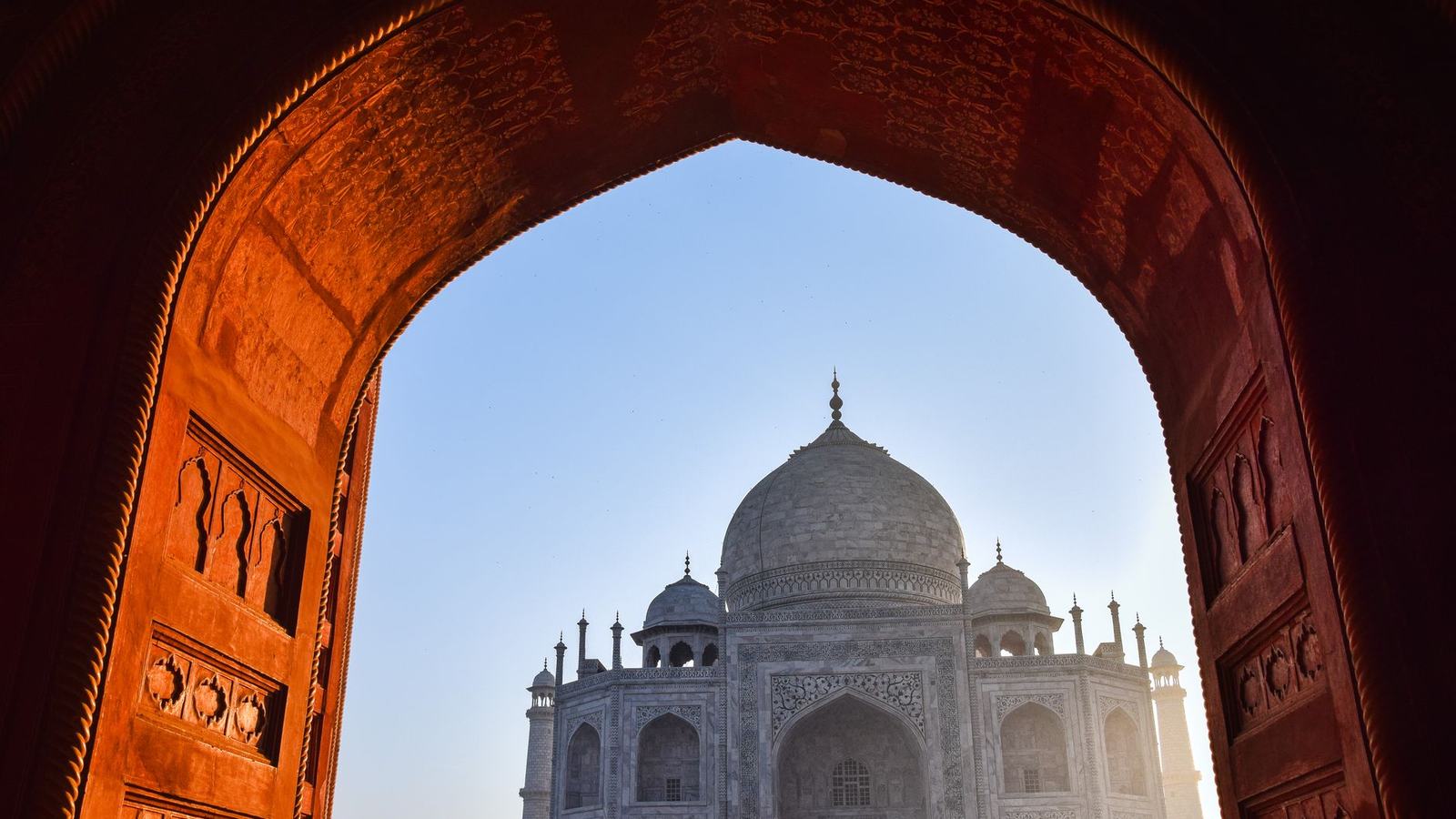
The Taj Mahal opens thirty minutes before sunrise and the first hour is unlike the rest of the day: mist on the Yamuna, the marble faintly pink, and a few hundred people rather than tens of thousands. Use the East Gate — the West Gate takes the coach parties and the South Gate is closed in the early morning — and buy the foreign-visitor ticket online in advance with the mausoleum add-on, which admits you inside the tomb chamber itself. Bags are searched; tripods, food and large bags are refused.
The complex is a sequence: the red sandstone Great Gate, the charbagh garden with its long reflecting channel, and then the mausoleum on its plinth, flanked by the mosque and the guest house. Walk the garden's side paths for the views the crowds miss, put on the shoe covers to climb the plinth, and go inside to see the pietra dura inlay — semi-precious stones set into marble in patterns of flowers — before the light and the heat build. The Taj is closed on Fridays for prayers.
Agra has more than the Taj. Agra Fort, three kilometres upstream, is where Shah Jahan was imprisoned by his son with a view of the mausoleum; the tomb of Itimad-ud-Daulah, the 'Baby Taj', is the inlay prototype; and Mehtab Bagh, the garden directly across the river, is the sunset viewpoint. Fatehpur Sikri, an abandoned Mughal capital an hour west, fills the afternoon.
From Delhi it is a long day trip or, better, one night. The Gatimaan Express leaves New Delhi early and returns in the evening; a chauffeur on the Yamuna Expressway takes three to four hours each way and lets you stop at Sikandra. Stay at one of the hotels with a Taj view from the room (the Oberoi Amarvilas is the famous one) and the sunrise walk is five minutes.
Three things to get right
- East Gate, thirty minutes before sunrise, mausoleum ticket bought online.
- Closed Fridays — plan the Delhi–Agra day around it.
- Mehtab Bagh across the river for sunset.
Book it
Nearest featured destination: Delhi — hotels, airport and activities on one page.