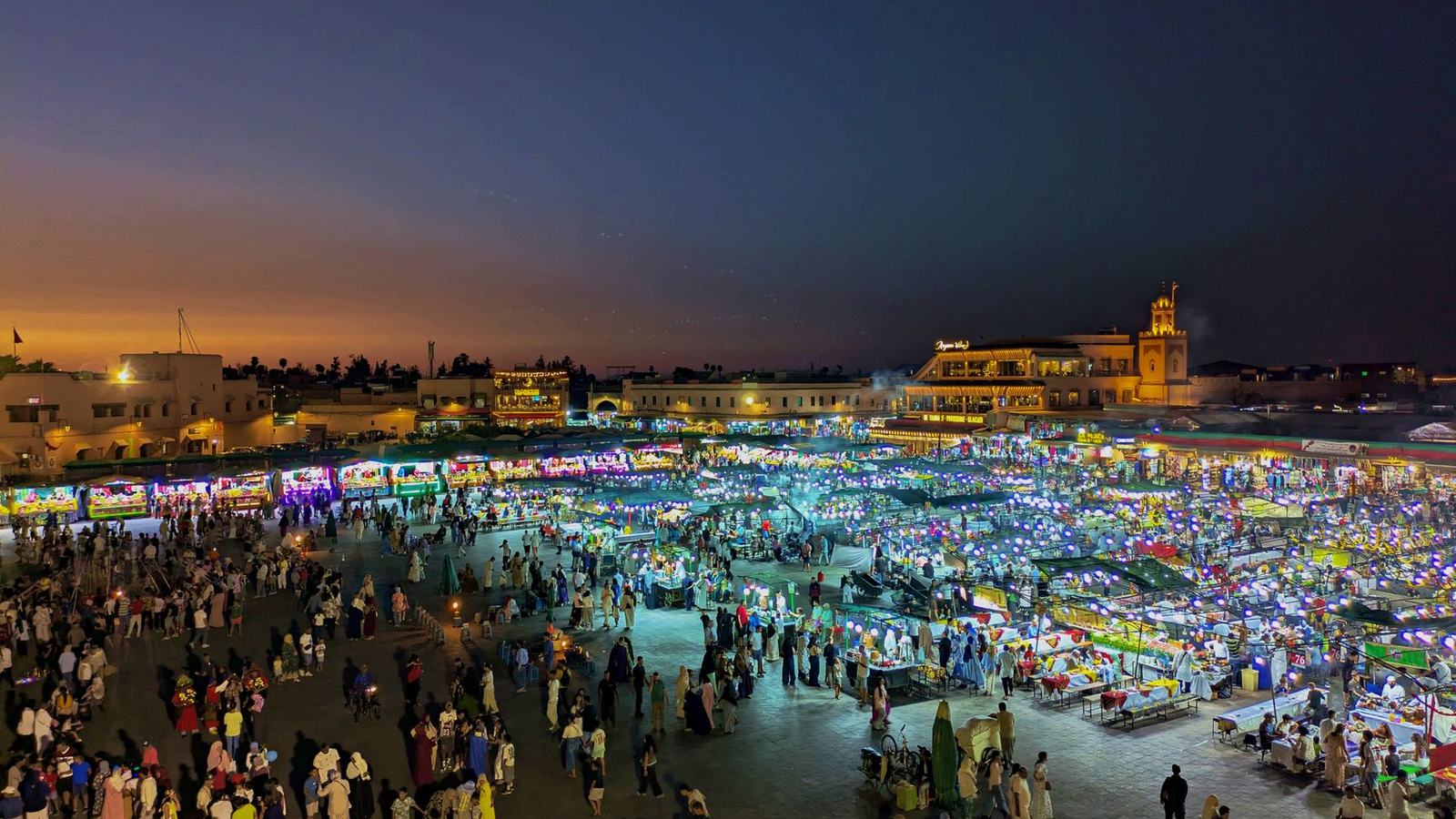
Jemaa el-Fnaa is the medina's living room. Around 5 p.m. the transformation starts: the juice carts are joined by rows of numbered food stalls under gas lamps, and the performers arrive — Gnawa musicians with iron castanets, storytellers holding circles of listeners, henna artists, snake charmers (give them a wide berth unless you want to pay for a photo you did not take). By nine the smoke from a hundred grills hangs over the square and the Koutoubia minaret glows behind it.
Take it in from above first. The cafés on the eastern side — Café de France, Le Grand Balcon — charge a mint tea for the terrace and give you the whole spectacle at a glance. Then go down. Eat at the stalls, but choose the busy ones with locals at the benches, agree prices before you sit, and expect a small 'bread and olives' charge to appear on the bill.
The souks fan north from the square in a maze that has confused visitors for nine hundred years. The trick is to keep the sun (or Koutoubia) on one side and to accept that getting lost for twenty minutes is the point. Offers to guide you back are a paid service; a firm 'la, shukran' ends it. Carpets, lanterns, leather and argan oil are the buys; bargain from about 40 percent of the first price.
Stay in a riad inside the medina — a courtyard house behind a plain door — and walk to the square. Your chauffeur will drop you at the nearest gate (cars cannot enter most of the medina), and a good riad sends a porter with a handcart for the bags. Book the transfer before you land; the airport taxi negotiation is not how to start a holiday.
Three things to get right
- Rooftop café at 6 p.m., the square at 8, the stalls at 9.
- Agree the price for everything — food, photos, henna — before it happens.
- Book a riad with a porter service and a chauffeur to the medina gate.
Book it
Nearest featured destination: Marrakesh — hotels, airport and activities on one page.